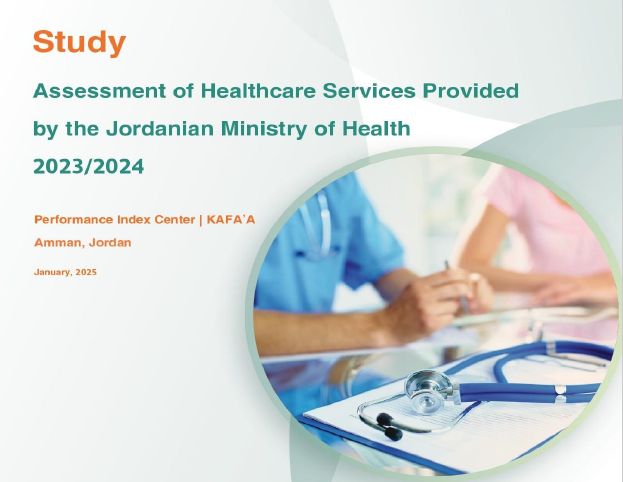
Assessment of Healthcare Services Provided by the Jordanian Ministry of Health (2023/2024)
The right to healthcare is one of the fundamental rights emphasized by international human rights law as well as the Jordanian Constitution. However, continuous population growth, economic challenges, technological developments, and geopolitical pressures have increased the strain on the public healthcare sector, highlighting the urgent need to improve services and address existing challenges.
The study shows that Jordan has made progress in some indicators, with government health expenditure at approximately 6.2% of GDP, and 99.9% of births attended by qualified medical staff, along with a continued decline in maternal and neonatal mortality rates. The study aims to provide a comprehensive perspective to support decision-makers in enhancing healthcare quality and ensuring services meet citizens’ needs.
Key Findings:
- Government health expenditure is about 6.2% of GDP, among the highest globally.
- 99.9% of births are attended by qualified medical staff.
- Maternal and neonatal mortality rates have decreased.
- Life expectancy in Jordan has declined from 76 to 74 years.
- Universal health coverage index dropped to 65%, returning to levels seen in 2000.
- Physician-to-population ratio is within global norms, pharmacists are three times higher than standard, while nurses are less than half, with a shortage of specialized nursing staff.
- Shortage of ICU and specialized beds relative to population needs.
- None of the Ministry of Health hospitals currently hold international accreditation, with the government aiming to accredit 100 hospitals by 2030 as part of its modernization plan.
- Medication and supplies wastage is estimated at 20–25%, around 60 million JOD annually, in addition to 12 million JOD wasted by citizens due to expired medicines at home.
To access the full study, please download it here👇