Policy Paper: Where Do Jordanian Women Stand in Global Indices?
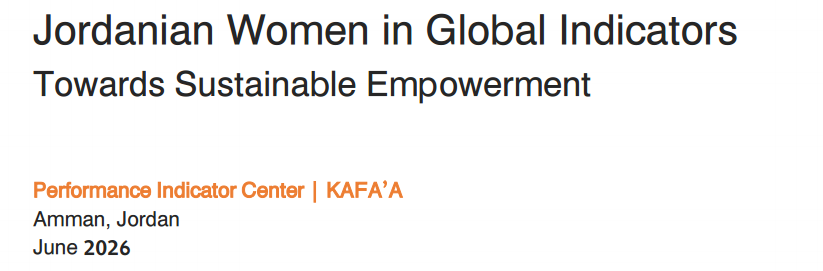
Performance Index Center | KAFA’A has launched a policy paper titled “Jordanian Women in Global Indicators – Towards Sustainable Empowerment.” The paper follows a specialized discussion session bringing together academics, activists, and experts in women’s empowerment and is grounded in an in-depth analysis of the study “Jordanian Women’s Performance in Global Indices (2018–2024).” The paper outlines a strategic framework to strengthen women’s role as active partners in sustainable development, moving from empowerment to genuine leadership and influence.
Where Do We Stand? From 2018 to 2026 in Numbers
The policy paper identifies notable progress in Jordan’s performance on the Global Gender Gap Index, with the country’s ranking improving from 138th in 2018 to 122nd in 2026. Women’s economic participation also reached its highest recorded score in recent years (0.552). Nevertheless, this progress masks persistent structural gaps. Despite women’s strong educational attainment, their economic participation remains below expectations, while political representation continues to rely largely on quota mechanisms rather than reflecting a sustainable cultural and institutional transformation.
Key Policy Proposals:
- Institutionalizing Performance Measurement: Building a unified national database to link empowerment policies to measurable national indicators, and developing dedicated indicators for women’s participation in cultural and creative sectors, contributions that are impactful yet invisible in current statistics.
- Enhancing Economic Participation Through Flexible Work Environments: Expanding flexible and remote work legislation, providing affordable childcare services, and improving safe and accessible transportation for women, especially in the governorates and remote areas.
- Directing Education and Training Towards Future Skills: Redirecting vocational and technical training toward AI, technology, and the digital economy, with sustained focus on women in less-served governorates.
- Moving Towards Leadership and Impact in Decision-Making: Strengthening women’s representation in decision-making positions in both public and private sectors based on competence and merit, and transforming women’s success stories into inspiring national models that challenge stereotypes.
Policy Observations and Recommendations
The paper affirms that legislative reforms such as quotas are a necessary first step but insufficient on their own without genuine cultural and institutional transformation. It recommends issuing strict equal pay legislation with deterrent penalties, integrating the cultural and creative dimension into national empowerment strategies, launching sustained national campaigns to challenge stereotypes, and extending flexible social protection to women in informal and agricultural sectors.
To view the full details, please download the paper below. 👇