Public Freedoms Index – Jordan 2026
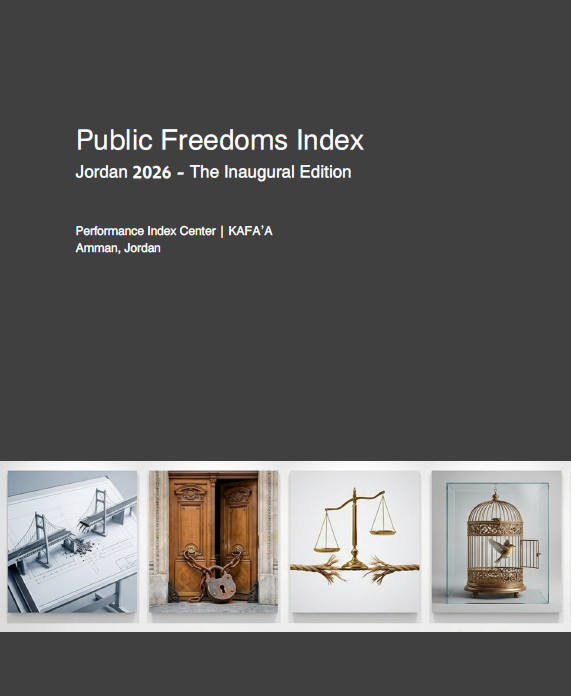
Performance Index Center | KِِِAFA’A has launched its first and foundational edition, titled “Public Freedoms Index – Jordan 2026,” providing a systematic assessment of the state of the civic and political space in Jordan. The Index is based on a hybrid methodology that combines the United Nations Human Rights Indicators Framework with the methodology of composite international indices, with the aim of transforming the public debate on public freedoms from general perceptions into a scientific measure that can be monitored and periodically updated
The Index results show that Jordan achieved an overall score of 53.9%, placing it within the “Inconsistent Freedoms System” classification. This result raises legitimate questions regarding the capacity of the institutional and administrative framework to keep pace with the relative progress reflected in constitutional and legislative provisions.
Key Findings:
- Overall Score and Classification: The Index achieved an overall score of 53.9%, reflecting a state of “fragile stability.” While the State has relatively advanced constitutional and legislative guarantees, reflected in an overall average of 0.62 for Structural Protection, these are accompanied by a gap in Operational Efforts (0.56) and a more pronounced decline in actual Results and Safeguards (0.50).
- Rule of Law – Highest-Performing Dimension: The Rule of Law dimension recorded the highest score among the five dimensions, at 69.8%, supported by a strong constitutional foundation and a relatively limited compliance gap between legal provisions and their implementation.
- Right to Peaceful Assembly – Lowest-Performing Dimension: The Right to Peaceful Assembly recorded the lowest score among the five dimensions, at 44.7%, reflecting administrative restrictions that, in practice, have transformed the requirement of “notification” into something resembling “prior authorisation.”
- Freedom of Movement – Widest Implementation Gap: Freedom of Movement scored 54.2%, yet it demonstrated the widest implementation gap across the Index, reflecting a significant divergence between the strength of constitutional protection and weaker outcomes in practice, particularly due to the broad use of administrative measures such as residence restrictions and compulsory residence orders.
- Political Participation: Political Participation scored 52.1%, making it the only dimension in which civic engagement and political awareness appear to have outpaced the capacity of the existing legal and institutional framework to accommodate them.
- Freedom of Opinion and Expression: Freedom of Opinion and Expression scored 48.8%, reflecting a persistent gap between the legal protection afforded to the right and the availability of a safe and enabling environment for its exercise, limiting its full impact in practice.
Recommendations:
KAFA’A recommends strengthening judicial oversight mechanisms and effective redress mechanisms, subjecting administrative decisions affecting public freedoms to rigorous judicial review, and aligning the executive and administrative framework with the relatively advanced level of constitutional guarantees.
The Center warns that if the gap between legal provisions and their implementation persists without systematic intervention, public freedoms may remain “confined to the realm of legislative promises,” rather than becoming rights that are effectively exercised and sustainably protected.
To access the full index, please download it from below. 👇