Policy Paper: The Jordanian Economy in Numbers, 2019–2025: Where Do We Stand?
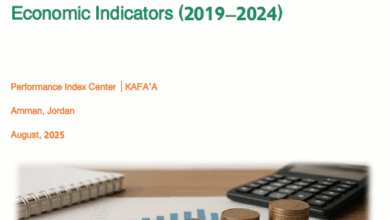
Performance Index Center | KAFA’A has launched a policy paper titled “The Jordanian Economy in Global Indicators: Reality, Challenges, and Reform Horizons,” following a specialized discussion session held by the Center under the title “The Jordanian Economy in International Economic Indices,” with the participation of a select group of economic experts. The paper analyzes the national economy’s performance across several key international indicators between 2019 and 2025. It provides decision-makers with a solid knowledge base to support strategic recommendations that align with the Economic Modernization Vision.
Where Do We Stand? The Jordanian Economy in Numbers (2019–2025)
GDP at real prices grew gradually from JOD 30.1 billion in 2019 to JOD 37.2 billion in 2025, achieving real growth of around 3.0% over the past year. Yet this aggregate growth has not translated into improved living standards: per capita GDP declined to $4,065 in 2025, compared to $4,705 in 2024 — a paradox that reveals a structural gap between overall growth and the actual improvement of citizens’ standard of living.
The Kingdom also faces significant fiscal and monetary challenges, most notably persistent unemployment above the 21% threshold, public debt climbing to around 117.4% of GDP as of February 2025, and a fiscal deficit after grants of JOD 2,256.3 million (5.2% of GDP) during the same year. On the other hand, Jordan achieved qualitative progress on the Human Development Index, ranking 99th globally in 2024 with a score of 0.754, while national exports grew by about 10% and foreign investment inflows rose by 25.1%.
Key Policy Recommendations:
- Reconsidering the Economic Modernization Vision: Enhancing its comprehensiveness and adequacy in addressing various economic challenges and ensuring it aligns with citizens’ lived reality.
- Achieving Fairness in the Distribution of Policy Impact: Reformulating fiscal and tax policies to serve the interests of different segments of society, expanding the tax base horizontally, and combating evasion rather than deepening the burden on compliant taxpayers.
- Strengthening Trust and Public Participation: Through transparency and governance of essential services, and engaging the private sector and civil society in setting development spending priorities.
- Governing Public Debt and Launching a Binding National Strategy: To gradually phase out debt-financing of the budget, with clear timelines and implementation mechanisms, and channel loan proceeds entirely toward investment projects.
- Moving Toward Zero-Based, Performance-Driven Budgeting: Abandoning the traditional incremental-increase approach to budget preparation in favor of a methodology reinforced by clear performance indicators (KPIs).
- Adhering to Royal Directives: Institutionalizing strict commitment to the Royal Letters of Designation and His Majesty the King’s Discussion Papers as a cross-government strategic framework, and orienting policies toward improving citizens’ standard of living.
Assessment and Future Outlook
The paper affirms that the stabilization of deficit rates above 5% in recent years, despite the structural reform programs adopted in cooperation with the International Monetary Fund, indicates that current efforts still require greater depth to address the structural roots of the crisis. The Center recommends a comprehensive review of public spending policies that goes beyond temporary solutions, alongside curbing the cost of public debt servicing, which alone drained 2,016.1 million dinars in 2025 — equivalent to one-sixth of the general budget.
To view the full details, access the full policy paper below. 👇