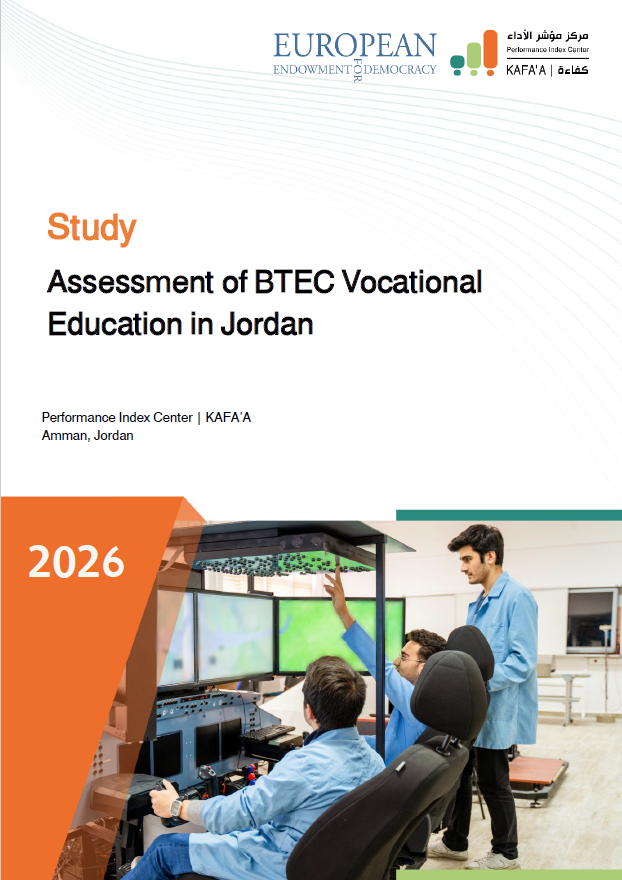
Study: Assessment of Vocational Education (BTEC) in Jordan
July 2026
This study is part of the series of analytical studies published by Performance Index Center | KAFA’A. It aims to provide a comprehensive assessment of the current state of implementation of the BTEC program in Jordanian schools, examining six core pillars: Resources and Quality of Education, Equity of Access, Training and Qualification, Awareness and Media, Progress Pathways and Higher Education, and Adequacy of Data. The study also reviews international experiences and explores the expected role of the program in achieving the objectives of the Economic Modernization Vision 2033.
The study adopts a descriptive-analytical approach, drawing on content and document analysis, interviews and focus group discussions with a sample of students, teachers, administrators, and private-sector representatives, in addition to analysing relevant statistical indicators and international experiences.
Key Findings:
- Scale and Expansion: The BTEC program is currently implemented in more than 330 schools. Data for the 2024/2025 academic year indicate that more than 33,600 male and female students are enrolled in the BTEC pathway at Levels 2 and 3. The total number of male and female students enrolled in BTEC programs in the Kingdom since its official launch in 2012 has exceeded 74,000.
- Alignment of Curricula with Labor Market Needs: The alignment of the BTEC program’s curricula and educational materials with the requirements of the Jordanian labor market received a score of 76.2%. Meanwhile, the satisfaction rate for the quality of practical and applied training that students receive within schools compared to theoretical instruction reached 66.6%.
- Private-Sector Partnership Gap: The findings indicate that cooperation between schools and the private sector to provide genuine field training opportunities remains limited, at only 51.6%, representing the lowest indicator within the Training and Qualification Pillar.
- Societal Awareness: The level of awareness of the value of the BTEC program among students and parents remains relatively modest, at 52.2%, reflecting the continued societal preference for academic education over vocational education and the persistent stereotypical perception of the vocational education pathway.
- International Comparative Performance: The retention rate into the second year of university for BTEC Level 3 (RQF) students reached approximately 91%, exceeding the OECD average of 88%.
For more information, please download the full study below. 👇